
Are Your Employee Benefits Helping You Keep Employees or Just Costing You Money?
Employee benefits are a significant investment for many businesses.
Health insurance, retirement contributions, paid time off, and other offerings can represent a substantial portion of your labor expenses. And with costs continuing to put pressure on business budgets, it’s reasonable to ask whether that investment is paying off.
But here’s something worth considering: Just because you’re spending money on employee benefits doesn’t necessarily mean those benefits are helping you retain employees.
The goal isn’t simply to offer more benefits. It’s to offer benefits that employees value, understand, and can realistically use.
So how do you know whether your benefits package is working?
1. Start With What You’re Actually Spending
Before evaluating the effectiveness of your benefits, you need to understand their total cost.
Most business owners know what they’re paying toward health insurance premiums. But that’s only one piece of the picture.
Depending on your offerings, your benefits expenses may include:
- Employer-paid insurance premiums.
- Retirement plan contributions or matching.
- Paid time off and other paid leave.
- Wellness programs and supplemental benefits.
- Administrative and benefits management expenses.
Try this: Calculate your annual employer benefits cost and divide it by your average number of eligible employees.
For example, if your business spends $180,000 annually on benefits for an average of 30 eligible employees, that’s approximately $6,000 per employee each year.
This calculation won’t tell you whether your benefits are effective, but it gives you a starting point for evaluating where your money is going.
2. Find Out Which Benefits Employees Actually Use
Offering a benefit and having employees take advantage of it are two different things.
A benefit might sound attractive when you’re selecting a package, but that doesn’t mean it fits your employees’ needs.
Review participation and utilization information available through your benefits providers.
Look for patterns.
Are employees participating in your retirement plan? Are optional benefits attracting interest? Are there programs that receive little engagement?
Low participation doesn’t automatically mean a benefit has no value. Employees may not understand it, may face eligibility restrictions, or may simply have different needs.
For health-related benefits, focus on appropriate aggregate information rather than individual employees’ medical or claims details.
Try this: Identify one or two benefits with low participation and investigate why before deciding whether to change or eliminate them.
You may discover that the problem isn’t the benefit itself, but how employees access or understand it.
3. Ask Employees What Matters to Them
It’s easy to assume employees want the same things you would want in their position.
But an employee supporting a family may prioritize health coverage, while another may place greater value on retirement contributions, paid time off, or scheduling flexibility.
Neither preference is necessarily more important. They simply reflect different circumstances.
Rather than guessing, ask.
A short, anonymous employee survey can provide useful insight into which benefits employees value and where they see gaps.
Consider questions such as:
- Which of our current benefits are most valuable to you?
- Are there benefits you find difficult to understand or use?
- Which additional benefit would make the biggest difference to you?
- How satisfied are you with your overall benefits package?
The important part is following through.
You may not be able to offer everything employees request, but understanding their priorities helps you make more informed decisions about where to invest.
4. Look at Benefits Alongside Employee Retention
If retention is one of the reasons you’re investing in benefits, it’s worth examining whether your benefits strategy is supporting that goal.
Start by reviewing employee turnover over the past year.
Are certain departments or positions experiencing higher turnover? Are employees leaving shortly after becoming eligible for benefits? Are compensation or benefits concerns appearing in exit interviews?
These patterns can help you identify areas worth investigating.
However, benefits are only one factor in an employee’s decision to stay.
Management, compensation, workload, advancement opportunities, and workplace culture all influence retention.
Try this: Compare your turnover trends with employee feedback and exit interview information.
If employees consistently mention inadequate benefits, that’s useful information. If they cite poor management or limited advancement, increasing benefits spending may not address the underlying problem.
The objective is to understand what’s contributing to turnover before investing in a solution.
5. Evaluate Value, Not Just Cost
When benefits expenses increase, the natural response may be to look for ways to reduce spending.
But the least expensive option isn’t always the best value, just as the most expensive package isn’t necessarily the most effective.
Before making changes, consider three questions:
- Does this benefit address a need employees have identified?
- Is the cost sustainable for the business?
- Does it support our broader goals for recruiting, retention, or employee well-being?
A benefit that employees genuinely value may justify its cost even if its impact on retention is difficult to measure directly.
On the other hand, a costly offering with little participation or employee interest deserves a closer look.
The goal is to make intentional decisions rather than automatically renewing the same package or adding benefits simply because competitors offer them.
Benefits Are Only Part of the Employee Experience
A thoughtful benefits package can be an important part of attracting and retaining employees, but it doesn’t work in isolation.
Employees also want to feel respected, supported, and appreciated for the work they do.
And unlike some traditional benefits, meaningful recognition doesn’t necessarily require a significant financial investment.
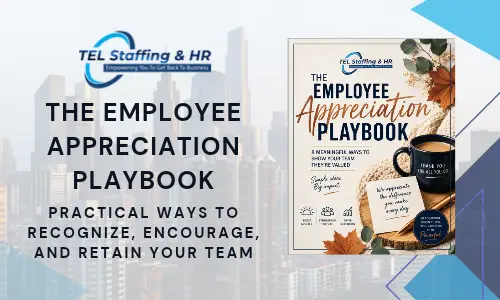
If you’re looking for practical ways to strengthen the employee experience beyond your benefits package, TEL Staffing & HR has created a free resource to help.
The Employee Appreciation Playbook includes eight actionable appreciation ideas, employee interest surveys, recognition tools, and ready-to-use printables designed to help businesses make employee appreciation part of their everyday culture.