
What Is It Really Costing You to Manage Everything In-House?
Running a business comes with expenses you can easily identify.
Rent. Utilities. Equipment. Supplies. Payroll.
But what about the costs that don’t show up as a separate line item?
The hours spent processing payroll, managing employee benefits, keeping up with employment regulations, coordinating vendors, and resolving administrative issues all come at a cost.
For many businesses, these responsibilities have simply become part of the daily routine. Someone handles them because they’ve always handled them.
But just because a task is being managed internally doesn’t necessarily mean it’s being managed cost-effectively.
So how much is your business really spending to keep everything running behind the scenes?
1. Start With the Expenses You Can See
The easiest place to begin is with the services and systems you’re already paying for.
Depending on your business, these might include:
- Payroll processing software or service fees.
- HR management systems and employee recordkeeping tools.
- Benefits administration expenses.
- Workers’ compensation administration and related services.
- Outside consultants or professional support.
Individually, these expenses may seem reasonable. But when several providers are involved, the combined cost can be significant.
Try this: Make a list of the services you currently use to manage payroll, HR, benefits, and employment-related administration.
Record the annual cost of each, including subscription fees, service charges, and additional expenses that aren’t covered by your standard agreements.
This gives you a clearer picture of what you’re spending before considering whether another approach might make sense.
2. Account for the Time You’re Spending
Not every administrative expense comes with an invoice.
Consider how much time you or your managers spend answering payroll questions, managing employee paperwork, coordinating benefits enrollment, or researching employment requirements.
Those hours have value, even when the work is being handled by someone already on your payroll.
Try this: For one week, track the time spent on employment-related administrative responsibilities.
Then calculate the approximate cost.
For example, if a manager earning $35 per hour spends six hours each week on these tasks, that’s $210 per week, or approximately $10,920 annually over 52 weeks.
And that’s just one person’s time, calculated using wages alone.
Now consider what else that manager could accomplish with some of those hours available.
The point isn’t that administrative work is unnecessary. It’s that the time required to complete it should be part of your cost evaluation.
3. Look for Duplication and Inefficiencies
Managing several providers can create additional work that isn’t always obvious.
Employee information may need to be entered into multiple systems. Reports may require manual reconciliation. A single employee change might involve contacting several different vendors.
And when something goes wrong, determining who is responsible for resolving it can take additional time.
Try this: Choose one routine process, such as onboarding a new employee.
Write down every system, vendor, and person involved from beginning to end.
How many times is the same information entered? How many separate steps require follow-up? Where do delays typically occur?
You may discover opportunities to simplify the process, even if you decide to keep everything in-house.
4. Consider the Cost of Specialized Expertise
Employment-related responsibilities involve more than paperwork.
Payroll tax requirements, benefits administration, employment regulations, and workers’ compensation can require specialized knowledge.
For smaller businesses, maintaining that expertise internally may be difficult. For growing businesses, the demands can become increasingly complex.
Outside support doesn’t eliminate an employer’s legal responsibilities, but it can provide access to knowledge and resources that may be difficult or expensive to maintain independently.
The question becomes whether your current approach provides the level of support your business needs.
5. Could a PEO Partnership Make More Sense?
A Professional Employer Organization, or PEO, provides businesses with access to a coordinated range of employment-related services through a co-employment relationship.
Depending on the agreement, these services may include payroll administration, employee benefits, HR support, workers’ compensation administration, and assistance with employment compliance.
The business continues directing its employees’ day-to-day work and operations, while the PEO takes on certain agreed-upon employer responsibilities and administrative functions.
For some businesses, this arrangement can reduce administrative complexity, provide access to specialized support, and potentially create efficiencies across multiple services.
But a PEO isn’t automatically the right solution for every business.
Before comparing providers, consider:
- What are we currently spending on these functions?
- How much internal time do they require?
- Which responsibilities are creating the greatest challenges?
- What services would a PEO actually provide?
- How do the total costs and support compare with our current approach?
Looking at the complete picture is more useful than comparing service fees alone.
The Goal Isn’t Just to Spend Less
Reducing expenses is important, but so is understanding what your business receives in return.
A less expensive service isn’t necessarily a better value if it creates additional administrative work or leaves your business without the support it needs.
Likewise, outsourcing doesn’t automatically mean everything becomes easier or less expensive.
The goal is to find an approach that makes financial and operational sense for your business.
You don’t have to manage every responsibility internally to maintain control of your business.
Sometimes the better decision is identifying which responsibilities deserve your direct attention and where a knowledgeable partner could provide greater value.
Is It Time to Rethink How You’re Managing Your Back Office?
TEL Staffing & HR works with businesses to help manage the employment-related responsibilities that come with running a company.
Through our PEO services, businesses can access coordinated support for payroll, HR administration, employee benefits, workers’ compensation, and other employment-related needs.
If you’re wondering whether your current approach is the most efficient or cost-effective option, a conversation about your existing processes and expenses is a good place to start.ery time it becomes vacant, that’s a challenge worth addressing before you’re hiring for it again.


Are Your Employee Benefits Helping You Keep Employees or Just Costing You Money?
Are Your Employee Benefits Helping You Keep Employees or Just Costing You Money?
Employee benefits are a significant investment for many businesses.
Health insurance, retirement contributions, paid time off, and other offerings can represent a substantial portion of your labor expenses. And with costs continuing to put pressure on business budgets, it’s reasonable to ask whether that investment is paying off.
But here’s something worth considering: Just because you’re spending money on employee benefits doesn’t necessarily mean those benefits are helping you retain employees.
The goal isn’t simply to offer more benefits. It’s to offer benefits that employees value, understand, and can realistically use.
So how do you know whether your benefits package is working?
1. Start With What You’re Actually Spending
Before evaluating the effectiveness of your benefits, you need to understand their total cost.
Most business owners know what they’re paying toward health insurance premiums. But that’s only one piece of the picture.
Depending on your offerings, your benefits expenses may include:
- Employer-paid insurance premiums.
- Retirement plan contributions or matching.
- Paid time off and other paid leave.
- Wellness programs and supplemental benefits.
- Administrative and benefits management expenses.
Try this: Calculate your annual employer benefits cost and divide it by your average number of eligible employees.
For example, if your business spends $180,000 annually on benefits for an average of 30 eligible employees, that’s approximately $6,000 per employee each year.
This calculation won’t tell you whether your benefits are effective, but it gives you a starting point for evaluating where your money is going.
2. Find Out Which Benefits Employees Actually Use
Offering a benefit and having employees take advantage of it are two different things.
A benefit might sound attractive when you’re selecting a package, but that doesn’t mean it fits your employees’ needs.
Review participation and utilization information available through your benefits providers.
Look for patterns.
Are employees participating in your retirement plan? Are optional benefits attracting interest? Are there programs that receive little engagement?
Low participation doesn’t automatically mean a benefit has no value. Employees may not understand it, may face eligibility restrictions, or may simply have different needs.
For health-related benefits, focus on appropriate aggregate information rather than individual employees’ medical or claims details.
Try this: Identify one or two benefits with low participation and investigate why before deciding whether to change or eliminate them.
You may discover that the problem isn’t the benefit itself, but how employees access or understand it.
3. Ask Employees What Matters to Them
It’s easy to assume employees want the same things you would want in their position.
But an employee supporting a family may prioritize health coverage, while another may place greater value on retirement contributions, paid time off, or scheduling flexibility.
Neither preference is necessarily more important. They simply reflect different circumstances.
Rather than guessing, ask.
A short, anonymous employee survey can provide useful insight into which benefits employees value and where they see gaps.
Consider questions such as:
- Which of our current benefits are most valuable to you?
- Are there benefits you find difficult to understand or use?
- Which additional benefit would make the biggest difference to you?
- How satisfied are you with your overall benefits package?
The important part is following through.
You may not be able to offer everything employees request, but understanding their priorities helps you make more informed decisions about where to invest.
4. Look at Benefits Alongside Employee Retention
If retention is one of the reasons you’re investing in benefits, it’s worth examining whether your benefits strategy is supporting that goal.
Start by reviewing employee turnover over the past year.
Are certain departments or positions experiencing higher turnover? Are employees leaving shortly after becoming eligible for benefits? Are compensation or benefits concerns appearing in exit interviews?
These patterns can help you identify areas worth investigating.
However, benefits are only one factor in an employee’s decision to stay.
Management, compensation, workload, advancement opportunities, and workplace culture all influence retention.
Try this: Compare your turnover trends with employee feedback and exit interview information.
If employees consistently mention inadequate benefits, that’s useful information. If they cite poor management or limited advancement, increasing benefits spending may not address the underlying problem.
The objective is to understand what’s contributing to turnover before investing in a solution.
5. Evaluate Value, Not Just Cost
When benefits expenses increase, the natural response may be to look for ways to reduce spending.
But the least expensive option isn’t always the best value, just as the most expensive package isn’t necessarily the most effective.
Before making changes, consider three questions:
- Does this benefit address a need employees have identified?
- Is the cost sustainable for the business?
- Does it support our broader goals for recruiting, retention, or employee well-being?
A benefit that employees genuinely value may justify its cost even if its impact on retention is difficult to measure directly.
On the other hand, a costly offering with little participation or employee interest deserves a closer look.
The goal is to make intentional decisions rather than automatically renewing the same package or adding benefits simply because competitors offer them.
Benefits Are Only Part of the Employee Experience
A thoughtful benefits package can be an important part of attracting and retaining employees, but it doesn’t work in isolation.
Employees also want to feel respected, supported, and appreciated for the work they do.
And unlike some traditional benefits, meaningful recognition doesn’t necessarily require a significant financial investment.
If you’re looking for practical ways to strengthen the employee experience beyond your benefits package, TEL Staffing & HR has created a free resource to help.
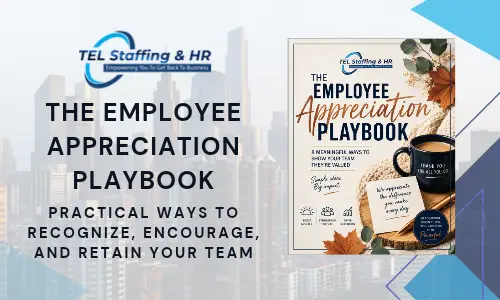
The Employee Appreciation Playbook includes eight actionable appreciation ideas, employee interest surveys, recognition tools, and ready-to-use printables designed to help businesses make employee appreciation part of their everyday culture.

Before You Set Your 2027 Business Goals, Take a Closer Look at Your Workforce
Workforce Planning for 2027: 5 Questions Business Owners Should Ask | TEL Staffing & HR
As the end of the year approaches, business owners start looking ahead.
Revenue goals. Budgets. Growth opportunities. New projects.
But before making plans for 2027, there’s one area worth reviewing: the people who will help you accomplish those goals.
Your workforce has been telling you something all year. It’s in your payroll reports, hiring records, overtime expenses, and employee turnover.
Here are five questions that can help you turn that information into better business decisions.
1. What Did Employee Turnover Actually Cost You This Year?
Most business owners know how many employees they’ve lost. Fewer have calculated what those departures actually cost.
Replacing an employee involves more than recruiting. There’s time spent interviewing, onboarding, training, and covering responsibilities while the position remains vacant.
Try this: Calculate your annual turnover rate by dividing the number of employees who left during the year by your average number of employees, then multiplying by 100.
For example, if 8 employees left and your average workforce was 40, your turnover rate would be 20%.
Then identify which positions experienced the most turnover and estimate the costs associated with replacing those employees.
The goal isn’t just to calculate a percentage. It’s to determine whether turnover represents an expense your business could reduce.
2. Where Did Your Labor Budget Go Off Track?
Labor expenses don’t always increase because you’ve hired more employees.
Sometimes additional costs come from overtime, unexpected absences, temporary coverage, or scheduling inefficiencies.
A department that consistently requires overtime may be understaffed. But it could also have an uneven workload or a scheduling problem.
Try this: Review your payroll reports and identify:
- Which departments generated the most overtime.
- Whether overtime occurred during predictable busy periods.
- How frequently you needed temporary or last-minute coverage.
Look for recurring patterns.
If you’re paying for the same staffing problem month after month, it may be time to reconsider how you’re scheduling or allocating your workforce.
3. Which Positions Were the Hardest to Fill?
Think about the positions you struggled to fill this year.
Were you receiving too few applications? Were candidates declining offers? Did your hiring process take too long? Or were new employees leaving shortly after starting?
Each situation points to a different problem.
Try this: Review your hiring activity and evaluate three things:
- Time to fill: How long did each position remain vacant?
- Candidate challenges: Where were you losing potential hires?
- Early turnover: How many new hires left within their first 90 days?
If the same position is difficult to fill every time it becomes vacant, that’s a challenge worth addressing before you’re hiring for it again.
4. Is Your Employee Training Actually Paying Off?
Training takes time and money. But completing a training session doesn’t necessarily mean an employee is better prepared to do the job.
Did this year’s training reduce mistakes? Improve productivity? Help employees take on additional responsibilities?
If you can’t identify what changed, it may be worth reconsidering how you’re measuring success.
Try this: Choose one training initiative and compare performance before and after implementation.
Look at measurable outcomes such as errors, productivity, customer complaints, or the number of employees qualified to handle additional responsibilities.
Not every improvement will appear in a report. Employee and supervisor feedback can provide valuable insight, too.
The important question is whether the training addressed a real business need.
5. What Do Your Employees Need That You Haven’t Asked About?
You can learn a great deal from workforce reports, but some of the most useful information won’t be found in your payroll system.
Do employees feel supported? Do they see opportunities to grow? Do they feel their contributions are recognized?
You may think you know the answers, but assumptions aren’t always accurate.
Try this: Ask employees three questions:
- What’s one thing that would make your job easier?
- Is there a skill or responsibility you’d like to develop?
- What makes you feel valued and appreciated at work?
Give employees an opportunity to respond honestly, then look for common themes.
You may discover opportunities to improve your workplace that require little financial investment.
Turn What You Learned Into a Plan
Answering these questions is a good start. The real value comes from what you do with the information.
You don’t need to overhaul your entire workforce strategy before January.
Instead, identify two or three areas where changes could make the greatest difference. Set a specific goal, determine how you’ll measure progress, and assign responsibility for following through.
The objective isn’t to enter 2027 with a longer list of things to do. It’s to make better decisions based on what you’ve already learned.
Don’t Overlook the People Behind the Numbers
As you review your workforce, remember that retention and engagement aren’t just about compensation, staffing levels, or performance metrics.
Recognition, personal connection, and opportunities for growth can also contribute to building a workplace where people want to stay.
If improving employee appreciation is one of your priorities for 2027, TEL Staffing & HR has created a free resource to help.
The Employee Appreciation Playbook includes eight practical appreciation ideas, ready-to-use printables, recognition tools, and employee interest surveys to help you get started.